
Torticollis Pt. 1
Are you a parent in Scottsdale, Arcadia, Biltmore, Phoenix, Paradise Valley or Tempe, AZ wondering if it's normal if your baby has a stiff neck? Or what it means if your baby has torticollis?
The good news is that you’re not alone, and we’ll even tell you how to pronounce it before you inquire about services!
Torticollis: how do you say it, what does it mean, how do I know if my baby has it, and what is it associated with?
Torticollis: Tor-ti-call-us is a description of the head and neck position of someone that presents with a tilt in one direction and a preference to rotate the head in the opposite direction of the tit; in other words, it's.a stiff neck. Think of that cute head tilt that the photographers who came to your school always asked you to do for the camera. Or when you say “treat” in front of a dog, and they do a head tilt to ensure they understood what you just said, but again, not being able to move it back into a position that looks and feels comfortable for them.
How can I tell if my baby has torticollis? Are there signs or symptoms I can screen for myself?
If you want to screen your baby for torticollis, start snapping photos head on to see if you notice if one eye/ear/ side of their mouth is always lower than the other. See if one of their ears is closer to the corresponding shoulder than the other, one shoulder/hip or knee is higher. A good rule of thumb is if you take a photo of them, you should be able to draw a straight line from the top, middle of their forehead, through their nose and chin, down their sternum and belly button, through the middle of their diaper. If you notice that you can't do that because their head is tilted one way, or their torso is in a 'c' shape, you should seek pediatric physical therapy immediately for early intervention. See the example picture below, where the baby is always looking one direction and therefore you can't see their right ear, their left eye is lower than their right, and their right knee is higher than their left. Conveniently, their shoulders are at the same height.
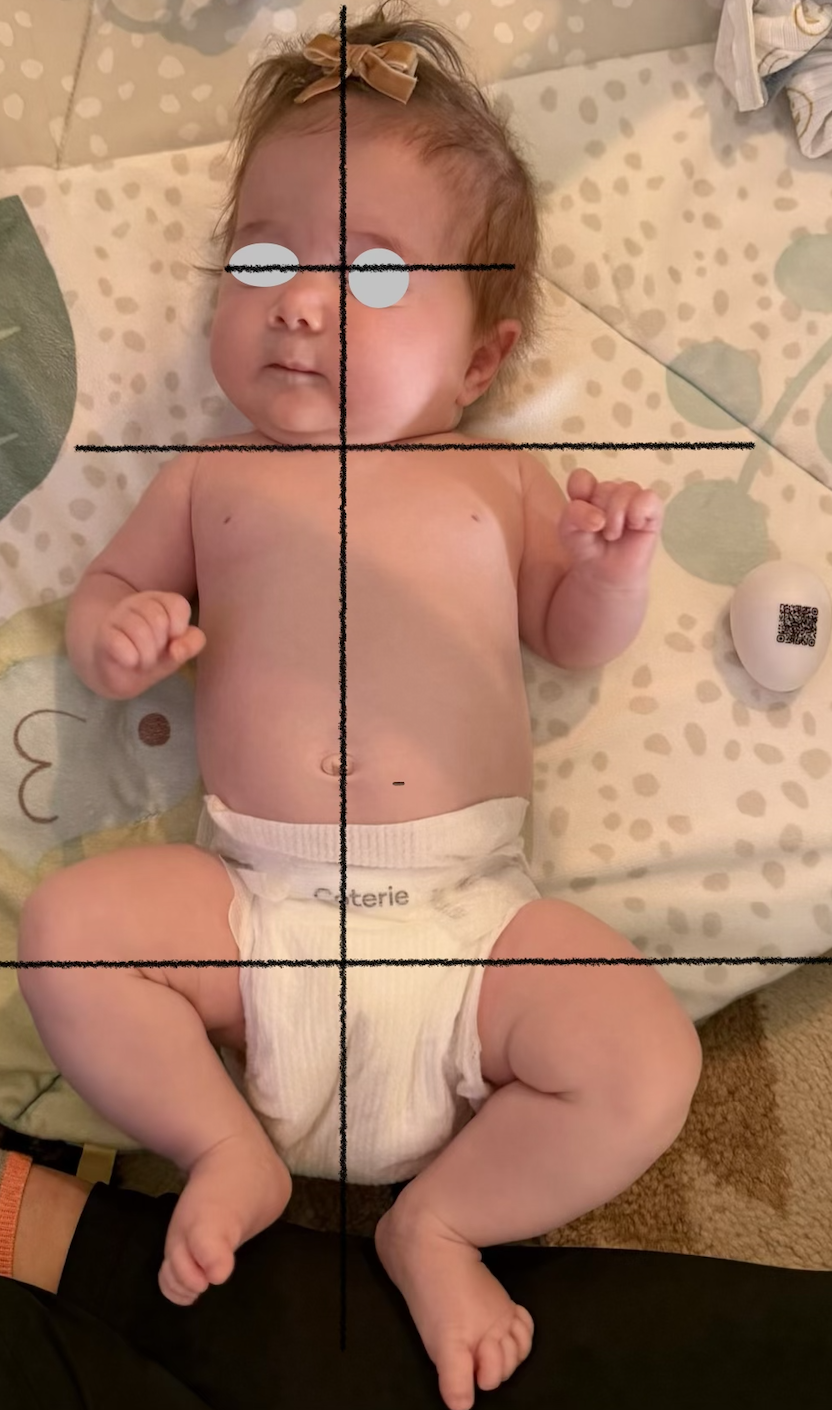
Start to monitor if they are preferring to look one direction over the other/ if baby always looks one direction/ if baby won't turn their head/ if they tend to over-use their eyes to look, while keeping their head still. Also note if they latch better (or not at all) on one side, reach or grasp more with one hand, or have started to develop a flat or bald spot on their head. Perhaps they have more, or thicker, skin folds/rolls on one side of their neck. Maybe they've even started to roll, and only roll onto their left or right side. These are all signs that you should have addressed in pediatric physical therapy.
Why didn't my pediatrician tell me about torticollis?
Pediatricians have to fit in a lot at well checks, and are only looking at specific symptoms for sick visits, so they may end up missing this even if they see your baby consistently; screening on your own is the best thing you can do for your child.
Still not sure if your baby has torticollis, or if you should seek physical therapy? Send them to us at 480-269-0173 or [email protected] and Dr. Nikki will take a look for you and give you recommendations during a free consultation based on what she observes- no appointment necessary!

Did I cause my baby to have torticollis? It is highly unlikely that any single factor 'caused' your baby's torticollis. It is associated with several risk factors that you have no control over. Torticollis is most often seen in first pregnancies, multiple births, longer babies, and males. It is often seen in babies who were born premature and spent time in the NICU, having insufficient strength or energy to move adequately on their own, or also demonstrating low muscle tone, or hypotonia. The good news is that torticollis has a very high success rate of being treated with stretches in physical therapy.
What is infant torticollis associated with? It is also highly correlated with a condition called plagiocephaly, or flat head syndrome. Plagiocephaly describes when the skull is not showing symmetrical development and roundness. There will often be a point where the skull is more flat or more protruding than the surrounding areas, or the opposite side. This is a heavily debated chicken or the egg scenario.
Often times, you’ll see these conditions go hand in hand because the preference to look one way often means there is more pressure on one part of the skull, and isolated pressure leads to asymmetry of the bones. If too much pressure causes a flat spot, the skull bones may compensate and start to jut forward in another direction on another part of the skull, in order for the brain to have sufficient space to develop. You’ll also see facial asymmetries associated with these conditions, due to the pressure and changing structure of the bones, but also because of the tightness of the muscle and underlying fascia.
Take a close look at your baby’s face if they have diagnosed plagiocephaly, and you may notice one eye is smaller than the other, one ear is higher than the other, and one side of the back of the neck has a larger, or more, skin folds than the other. In some cases, depending on severity and age of intervention, a DOC band (baby helmet) may be recommended to address your child’s plagiocephaly. This is why we recommend early intervention as early as possible; it only becomes more difficult to address the heavier, stronger, and opinionated your baby becomes.
Keep reading more on our torticollis part 2 blog to learn what you can do and how early intervention helps.

Don't wait to schedule your baby's pediatric physical therapy evaluation for torticollis or plagiocephaly with Moving and Grooving Pediatric Physical Therapy; the sooner you start, the faster you'll see them gain comfort and symmetry and reduce their neck tightness.
